Mostrando entradas con la etiqueta ARAGON. Mostrar todas las entradas

sábado, 25 de enero de 2020

UNIT 7. THE GREAT PENINSULAR KINGDOMS (13th-15th CENTURIES).

1. THE RECONQUEST DURING THE 13th CENTURY: LAS NAVAS DE TOLOSA.

At the beggining of the 13th century Castile form an alliance with Aragon and Navarre to defeat the Almohads.
The almohad army was destroyed in the battle of Las Navas de Tolosa and the muslims taifa never recovered. During the 13th century and the early 14th century, the Christian Kingdoms conquered all the muslims territories except the Nasrid Kingdom of Granada.

1. 1. Castille.

During the 13th century Castille crossed Sierra Morena and conquered the Guadiana and Guadalquivir Valleys, about 125.000 km2 in 30 years. The expansion was led by:
  • Ferdinand III conquered the Baja Extremadura and the Guadalquivir Valley.
  • Alfonso X conquered Huelva and Cadiz.
  • At the end of the 13th century, Tarifa was occupied to control the Strait of Gibraltar.

14th century.

The Nasrid Kingodm tried to recover the Strait of Gibraltar with the help of the Marinid Kingdom, but they were defeated by Alfonso XI in the Battle of Rio Salado (1340)
The crisis of the 14h century stopped the expansion of the Christian Kingdoms.

1. 2. Aragon.

In the early 13th century, the king of France took the Occitanian territory from Aragon. The excuse was the persecution of the Albigensians and the aragones king Peter II was defeated and killed in Muret (1213)
His son, James I the Conqueror continued the expansion to the south:
  • 1229 he conquered Mallorca and Ibiza.
  • 1238 Valencia and a part od Alicante.
  • 1244, Teatry of Alzira, signed by James I and Alfonso X of Castille, which meant that Murcia remained part of Castille.


2. THE RESETTLEMENT.

The ressettlement of the territories occupied during the 13th century was different from before:
  • The occupation was carried out by nobles and the military orders that received in return vast expanses of land (latifundia).
  • Many muslims stayed, keeping their religion and customs. They were called mudejars (mudejares).

2. 1. Military orders and latifundia.

The military orders were Christians societies of knights dedicated to war and prayer. They were led by a grand master. They were granted large plots of land (latifundia) with castles to protect them. This took place in the Jucar, Turia and Guadiana Valleys

2. 2. Repartimientos.

A land grant (repartimiento) was a donation of land (including villages) to those who had participated in the conquets. The main beneficiaries were: the military orders, the nobility and the Church.
A capitulation was a contract made by the new inhabitants that promise to respect the law, religion and propery of the Muslims (Mudejars) that had to lived in Muslim quartes (morerias). This took place in Extremadura, the Guadalquivir Valley, the Balearic Islands, Murcia and Valencia.

3. THE CROWN OF CASTILE.

 After the unification of Leon and Castile in 1230, the Crown of Castile becme the largest kingdom in the Peninsula.

3. 1. Goverment of the kingdom.

The goverment was composed of three institutions: the monarchy, the Cortes and the municipal councils.
  • the monarchs accumulated more power including tha ability to raise armies and collect taxes and new institutions helped them:
  1. the Treasury, to collect taxes.
  2. the Chancery, to organise the kingdom.
  3. the Audience, administration of justice.
  • The Cortes of Leon were created in 1188, when the king allowed representatives of the cities to join the King's Council.
  • Municipal councils controlled by the nobility (regidores), althought the monarchy appointed corregidores to exercise control.

3. 2. Economy.

Most people worked in agriculture:
  • cereals to feed themselves.
  • gravepines and olive trees for export.
The most important economic activity was Merino sheep farming which produced exceptional wool and was controlled by the nobility, military orders and monasteries.

3. 3. Society.

In the 14th century, Castile had four million inhabitants. Was a estamental society and the main minorities were:
  • the jews lived in the societies and worked in trade and finance.
  • the muslims worked in agriculture and lived in the Tajo Valley and Murcia.

3. 4. The Cortes.

The Cortes were metting of representatives of the three estates (the clergy, the nobility and the ordinary people), summoned by the king and that were held in different cities. The functions of the Cortes were:
  • to approve laws propossed by the king
  • to raise taxes (subsidies) to cover his financial needs.
  • to present complaints and request of the estates to the king.

4. TRANSHUMANCE.

Transhumance was the practice of moving livestock from one place of pasture to another. During the summer castilian farmers took their livestock to the pastures of the Cordillera Cantabrica or the Sistema Central to be fattened on the high pastures and regrow their wool, an in winter  returned to the lowlands of Extremadura or Castile.

4. 1. Transhumance an the Mesta.

King Alfonso X established the Mesta (1273) , an association that looked after the interest of livestosk farmers. Its aim was to avoid conflict between arable farmers and shepherds, as the sheep had to cross the lands od arable farmers twice a year, causing damage.
The monarchs gave many privileges to the Mesta.

4. 2. The importance of wool trade.

The flocks of sheep belonged to the high nobility which exported it to textile mills in northern Europe.
The wool for export was sent to Burgos, and from there travelled to the coastal villages of northern Santander (Hermandad de las Cuatro Villas) and was shipped to Flanders.
The export of raw wool was very atractive for the nobility but had negative consequences:
  • hindered the developemnt of Castilian cloth manufacturing.
  • obstructed the growth of the bourgeoisie.

4. 3. The castilian fairs.

  The wool trade reactivated the comercial life of the Meseta Norte, and led to the creation of fairs and markets: Rioseco, Valladolid and Medina del Campo, among others.


5. THE CROWN OF ARAGON.

5. 1. Goverment.

The Crown of Aragon was divided into several territories with each own institutions and laws. The goverment was based on pactismo: the king agreed to share the creation of laws with the Cortes and to respect the rights of the three estates (fueros). The main institutions were
  • the Cortes, one in each kingdom: granted subsidies to the king and passed laws.
  • the viceroy, the king's representative in each kingdom.
  • the Generalidad or Diputación del General, a permanent comission of the Cortes that defended the Fueros and enforced the decisions of the Cortes.
  • the Chief o Justice of Aragon, who mediated in disputes between the king and the nobility.

 5. 2. Economy and society.

  • The most important economic activity was agriculture and livestock farming: Mediterranean trilogy, rice and vegetables.
  • Artisanship: ironwork and manufacture of cloth.
  • Trade.
The growth of trade led to the emergenc of the bourgeoisie which controlled the assembly of Barcelona (Consell de Cent). 

5. 3. Mediterranean expansion.

In 200 years the Crown of Aragon expanded its territory across the Mediterranean Sea, thanks to the financial support of Catalan, Mallorcan and Valencia merchants:
  • Sicily (Sicilia) 1282.
  • Athens and Neopatria (Atenas y Neopatria) in 1313
  • Naples (Nápoles) in 1442.

 6. THE KINGDOM OF NAVARRE.

6. 1. Several dinasties, only one fuero.

After the death of Sancho VII in 1234, Navarre was ruled by three dinasties of french origin: Blois, Capet and Evreux.
The monarchs had to swear loyalty to the General Charter (Fuero General) which establised the rights and duties of the inhabitants of the kingdom.
The king ruled helped by:
  • the Royal Council that was chosen by the king.
  • the High Court in charge of justice.
  • the General Auditing Office which controlled the the Royal Treasury.

District and social groups.

In the 13th century, Navarra had 150.000 inhabitants and was divided in four districts and a territory in modern day France: Ultrapuertos.
The nobles based their wealth in land and livestock farming and Christians, Jews and Mudejars lived together.

  Economy.

The main economic activites were:
  • livestock farming and vegetable farming in la Ribera Tuledana.
  • Artisanship and trade in The Camino de Santiago.

 Navarrese civil war: agramonteses and beaumonteses.

Chronology: 1451-1512.
Causes:
  • the death of the queen Blanche of Navarre in 1441started a sucessory conflict between her husband John II of Aragon and her son, Charles, prince of Viana.
  • the rivalry between two groups of nobles which began in the 14th century:
  1. the agramonteses, they represented the Franco-Navarrese nobility and the farmers of the Pyrenees. They defended the livestock farming and supported John II.
  2. the beaumonteses. They represented the farming nobles of the Ribera. They supported Charles of Viana and later Castile.
Result: After the death of John in 1479, Navarra was ruled by a French dinasty, but in 1512, Ferdinand the Catholic, invaded it with a castilian army and united it with the Crown of Castile.

7. CIVIL WARS IN CASTILE AND ARAGON.

The Late Middle Ages was a time of crisis for the Iberian Peninsula due to:
  • the Black Death.
  • famine.
  • economic crisis:
  1. reduction of mediterranean trade.
  2. smaller harvest.
  • civil wars.

 7. 1. Black Death and progroms.

After a series of bad harvests, the Black Death reached the Peninsula via the Mediterranean Sea, spreading quickly to the rest of the Peninsula. The consequences were:
  • many areas were abandoned.
  • the lords demanded more lands from the king and increased peasants' taxes.
  • Jews were blamed for the crisis an 1391 there mass killings of jews in various cities (progroms).

7. 2. Conflicts in the Crown of Aragon.

In the 15th century a new dinasty ruled Aragon, the Trastamara dinasty. In 1410, Ferdinand the Antequera was chosen to be king by the Compromise of Caspe
There were social conflicts due to the demografic and economic crisis:
  • Peasant revolt. The peasants (remences) rose against the lords because of the increase of th rents and the feudal abuses (malos usos).
  • In Barcelona, a conflict between the Busca (traders and artisans) and th Biga (nobles and bourgeoisie).
There was a civil war (1462-1472) between the King John II supported by the Busca and the peasants and the nobility. The king won.

7. 3. Castile.

During the 14th century the castilian nobility tried to recover their privileges. The monarchy was controlled by the nobility and the favourites. The main conflicts were:

  • 1st castilian civil war (1366-1369. between:
  1. King Peter I that wanted to strengthen royal authority
  2. The hig nobility that supported Henry og Trastamara.
Henry won and granted lands and privileges to th enobles.
  • 2nd castilian civil war (1475-1479) after the death of Henry IV between:
  1.  his sister Isabella
  2. his daughter Joanna.
Isabella won and assert the royal authority.

7. 4. The Irmandiño revolt.

A revolt of the farm laboures (irmandiños) against the feudal lords in 1467.

8. CULTURE.

Three different cultures lived alongside in the Iberian Peninsula during the Middle Ages: Muslims, Christians and Jews. Their main contributions were:

Jews.

The most important figures were:
  • Ibn Shaprut, a doctor in Cordoba during the 10th century.
  • Maimonides, a thinker, physician and astronomer.

 Muslims. 

The most important contributions of the mudejars, the muslims living in the christian kingdoms were:
  • the mudejar art.
  • the words of arabic origin.
  • the main figuro was Averroes who recovered the ideas of Aristotles.

 The School of translators of Toledo.

Alfonso X the wise created the School of Toledo which translated and copied literary, philosophical, medical an scienfitic text from Greco-Roman, Muslim and Jewish cultures.


miércoles, 25 de diciembre de 2019

UNIT 4. THE ORIGIN OF THE FIRST PENINSULAR KINGDOMS (8th-13th CENTURIES).

1. THE ORIGIN OF THE CHRISTIAN KINGDOMS.

Only a narrow stretch of land in the north of the Iberian Peninsula remained outside the control of the Cordoba's Emirate.
Nevertheless, the internal conflicts in Al-Andalus during the 8th century, favoured the formation of two areas that resisted the islamic role:
  • a territory around Asturias, where some Visigothic noble had fled from the islamic conquest.
  • several counties in the Pyriness which were a part of the Marca Hispanica.

1. 1. The kingdom of Asturias.

At the beggining of the 8th century, some local leaders from Asturias rejected the authority of the emirs of Cordoba. One of them, Pelagius, defeated the muslims in the battle of Covadonga (722 AD) and the muslims abandoned the territory.

During the 8th and 9th centuries, the kingdom of Asturias started to expanse:
  • Alfonso I (8th century) conquered Galicia.
  • Alfonso II (9th century) established the capital in Oviedo and introduced the Visigothic laws.
Asturian art.
The art of the kingdom of Asturias mixed the visigothic traditions with new elements:
  • rounded arch.
  • barrel vault.
  • external buttreses.

 1. 2. The Marca Hispanica.

During the 8th century, Charlemagne occupied Pamplona, Jaca, Girona and Barcelona, although he was not able to reach the Ebro River. This territories became the Marca Hispanica, a fortified zone to reinforce the border of his kingdom. The Marca Hispanica was divided in counties who swore loyalty to the king.
After the death of Charlemagne, the counties became independent:
  • the kingdom of Pamplona.
  • the Aragonese counties.
  • the Catalan counties.


Santa Maria del Naranco. Imagen de Anne Wipf en Pixabay.


San Miguel de Lillo.


 2. FROM THE KINGDOM OF ASTURIAS TO THE KINGDOM OF LEON.

2. 1. The occupation of the Duero river.

In te second half of the 9th century, Alfonso III (866-910) conquered the region between the Cordillera Cantabrica and the River Duero, taking advantage of the internal conflicts of the emirs of Cordoba., including cities like Astorga, Porto, Leon y Astorga.

2. 2. The creation of the kingdom of Leon.

  • In the 9th century, peasant families from the Cantabrian valleys were encouraged to move to the Duero Valley to occupy it.
  • Ordoño II moved his court to Leon to control the Duero Valley in 914 AD. The kingdom of Asturias became the kingdom of Leon.

2. 3. 10th century: a stable border.

  •  In the 10th century, the kingdom of Leon reached the River Tormes, conquering Salamanca and Avila.
  • The Cordoba's caliphate, led by Al-Mansur, stopped its expansion, launching raids against Santiago, Leon and Zamora. Because of that, Leon tried to secure the frontier along the Duero River.


2. 4. The origin of Castile.

  • Most of the Muslim attacks on Leon came from the east (La-Rioja, Alava and Burgos). Because of this, Alfonso III built castles and lands to several counts in this region, that became known as Castile, land of the castles.
  • The counts started to act independently and in 10th century, the count Fernán González united all the counties in Castile, creating the County of Castile.
  • In the 11th century, the County of Castile became a part of the Kingdom of Pamplona, but in 1035 became independent again with Ferdinand I. In 1037,Ferdinand became the king of Leon.

Activity:

Ho wto write History-The battle of Covadonga


Kingdom of Leon in 910 AD.


3. THE PYRENEAN COUNTIES AND KINGDOMS.

In the 9th century the territories of the Marca Hispanica became independent from the Carolingian Empire:
  • Kingdom of Pamplona.
  • Kingmo of Aragon.
  • Catalan counties.

 3. 1. Kingdom of Pamplona.

Was located between the Arga and Aragon rivers an inhabited by basques. Led by the families Arista and Jimena fought against the Franks and the Muslims.
Finally, the Arista dinasty expelled the Franks, establishing the Kingdom of Pamplona.
In the 10th century, Pamplona conquered Álava, La Rioja and the County of Aragón.

3. 2. Aragón: from county to kingdom.

  In the 9th century, the Aznar Galíndez family created the County of Aragon. Later, the counties of Sobrarbe and Ribagorza joined Aragon and in the 11th century appeared the kingdom of Aragon.

3. 3. The catalan counties.

  In the 9th century, Wilfred the Hairy (Wilfredo el Velloso), count of Barcelona annexed most of the Catalan counties and made his position hereditary.
His grandson, Count Borrel II, made the counties independent from the franks in 987 AD.
In the 11th and 12th centuries, the catalan counties expanded into Occitania (north of the Pyrenees) and towards the Ebro Valley.

3. 4. Sancho III "the Great".

Sancho III (1004-1035) inherited the Kingdom of Pamplona and thanks to marriage alliances and military skills he conquered:
  • the counties of Castille, Aragon, Sobrarbe and Ribagorza.
  • most of the Kingdom of Leon.
Navarra became the most powerful kingdom in the Peninsula, but when he died his kingdom was divided among his sons, creating the kingdoms: Castile and Leon, Pamplona and Aragón.

The kingdom of Pamplna under Sancho III the Great. File: Mapa de las expansión de los reinos cristianos por la Península Ibérica en el s. XI. Author: José Alberto Bermúdez. License: CC BY-NC-SA 3.0


 4. THE CAMINO DE SANTIAGO.

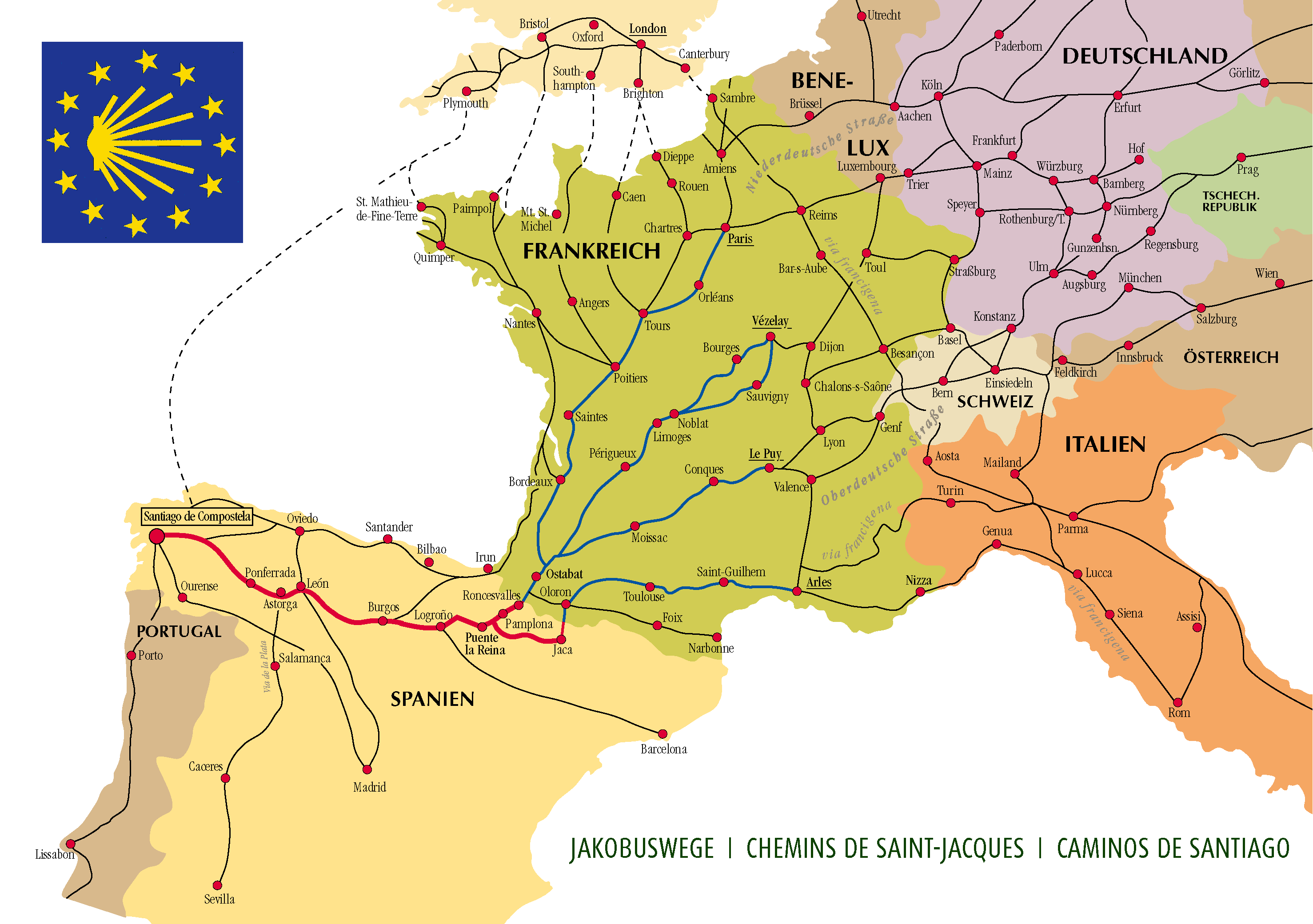
In the 9th century, the tomb of St. James was found in Galicia, near Finisterre. The location was named, Compostela. Alfonso II ordered the construction of a church on the site of the tomb of Saint James.
In the 11thc entury routes to Santiago were organised from different parts of Europe, the Camino de Santiago.

4. 1. The Jacobean  route.

In the 9th century, the tomb of St. James was found in Galicia, near Finisterre. The location was named, Compostela. Alfonso II ordered the construction of a church on the site of the tomb of Saint James.
The Camino de Santiago was a network of routes to Santiago organised from different parts of Europe from the 11th century and used for Christian pilgrims who wanted forgiveness for their sins. The Camino became a cultural and commercial exchange:
  • towns grew along the road: Jaca, Estella, Pamplona, Logroño, Burgos, Leon.
  • Inns (posadas), hospitals (hospitales) and churches were built.
  • The Romanesque (Romanico) and Gothic (Gótico) styles of architecture spread through the Iberian Peninsula.

4. 2. The pilgrimmate.

The pilgrims walked to Santiago in groups for protection and wore a scallop shell to identify themselves.
Their final destination was the Cathedral of Santiago where they visited the tomb of the apostle.


Way of St. James road network. File:Ways_of_St._James_in_Europe.png Autrhor: Manfred Zentgraf, Volkach, Germany License: CC BY-SA 2.5


5. The advance of the christian kingdoms.

5. 1. The taifa kingdoms.

After the fall of the caliphate (1031 AD), Al-Andalus was divided into small kingdoms (taifa). This kingdoms were weak and paid parias (an annual tribute in gold in exchange for a temporary truce) to the christian kingdoms.
The christian kingoms used this money to built stronger armies and during the 11th and 12th centuries conquered the valleys of the rivers Tajo and Ebro.

5. 2. The kingdom of Castille and Leon.

  • Ferdinand I (1037-1065) conquered the provinces of Salamanca and Avila.
  • Alfonso VI (1065-1109) conquered Toledo, Madrid and the center of the Peninsula.
  • Alfonso VII (12th century) was proclaimed "Emperor of All Spain" and  all the other peninsular kingdoms paid him vassalage.
Nevertheless the castilian advance was stoped by the Almoravids and the Almohads. The almoravids defeated Alfonso Vi in Sagrajas (1086), and later the Almohads defeated the Christians in Alarcos but later they were defeated in Las Navas de Tolosa (1212).

5. 3. The conquest of the Ebro Valley.

Navarra.

Navarra was unable to expand south due to Castille and Aragon and by the 13th century was ruled by French dinasties.

 Crown of Aragon.

  • During the 11h century Aragon conquered the province of Zaragoza, and the County of Barcelona conquered Tarragona and expanded into Occitania (south of France).
  • During the12th century, Ramon Berenguer IV (1131-1162) conquered the rest of Catalonia and Alfonso II, Teruel.


Spain in 1100 AD.


The Christian kingdoms during the 12th century. File: La Reconquista, siglo XII. Author: Alejandro Cana Sánchez. License: (CC BY-NC-SA 3.0)


 6. THE RESETTLEMENT.

 6. 1. Definition and types.

The Resettlement (in spanish, Repoblación) was the occupation of land that had been deserted (Ebro Valley, Plain of Vic) or taken from Al-Andalus (the Tajo and Ebro Valleys) by the Christian kings. We can distinguish two types of resettlement:
  • Free resettlement (in spanish, repoblación libre) (pressura or aprisio, 9-10th centuries). Small plots of lands were given to free peasants that founded villages. The settlers owned small plots of land (allods) and held pastures, water and forests collectively as public property.
  • Concejiles resettlement (in spanish, repoblación concejil) (11-12th centuries) organised by the monarchs in areas of the border with Al-Andalus. To encourage the settlement of cicities, the monarchs granted privileges:
  1. municipal charters, collective contracts that established the conditions for cultivating the land.
  2. fueros, rights, liberties and ta exemptions granted to the inhbitants of a city.

6. 2. Organization of the settlements.

  • Most of the settlements were small villages inhabited by free peasants.
  • They cultivated wheat and gravevines using oxens to work the land. The houses had vegetable gardens and a barn for a cow, some pigs and chickens.
  • The villagers meet in a council to discuss communal matters. 
  • Most of th resettlers were Cantabrian or Asturians, bu also Christians from Al-Andalus (Morzarabs).

6. 3. Mozarabic art.

Small churches built by the Mozarabs in the 9th and 10th centuries. Their main characteristics were:
  • Built in stone with thick walls and sparsely decorated.
  • Use of horseshoe arches.
  • Columns with capitals decorated with plant motifs.


7. THE CONSOLIDATION OF THE PENINSULAR KINGDOMS.

7. 1. The Crown of Castille.

The kingdoms of Castille and Leon were finally unified in 1230 with Ferdinand III. He created the Crown of Castille that became the most important peninsular kingdom.

7. 2. The kingdom of Portugal.

  • Portugal was a part of the Kingdom of Leon that became a county in the early 12th century.
  • Became independent in 1128 when Alfonso Enriques proclaimed himself king.
  • Portugal started to expand south.

 7. 3.  The crown of Aragon.

In 1137, Petronila the daughter of Ramiro II, the king of Aragon, married Ramon Berenguer IV, count of Barcelona, creating the Crown of Aragon. His son, Alfonso II controlled the kingdom of Aragon, the catalan counties and Occitania.

8. EL CID.

Rodrigo Díaz de Vivar (1043-1099) was a member of the castilian lower nobility, a knight without lands. There were three ways that a knight could use to became rich: fight for the king, win battles or marry a wealthy woman.

8. 1. Castile and Leon.

Rodrigo was educated with the prince Sancho. When Sancho became king, he made Rodrigo royal standard-bearer. After the dead of Sancho, Rodrigo served under Alfonso VI and married Alfonso's niece in 1074.
Later he was accused of launching a expedition to take Toledo without permision and was exiled (1081.

8. 2. Al-Muqtadir.

He became the head of the armies of the king of Zaragoza betwen 1081 and 1086. He was known as sidi (lord).

8. 3. Reconciliation with Alfonso and second exile.

In 1086, Rodrigo reconciled with Alfonso and left from Levante where protected the allies of Alfonso and forced the muslim kings to pay parias to Castille.
In 1089, Rodrigo was accused of treason again and force to exile. Then, he decided to act on his own, becoming the most powerful leader in the Levante. In 1094 he conquered Valencia and established a christian taifa under his own rule.